

Navigator
In this section:
Navigator is an AI-powered assistant that delivers personalized, context-specific security guidance directly within SD Elements. It helps teams quickly access security knowledge, retrieve relevant project insights, and get actionable answers to common security questions — all in natural language.
| Navigator is available to organizations that If it’s not visible in your instance, please reach out to your Account Team. |
| Navigator follows existing SD Elements permission settings. Users will only be able to retrieve information from data they already have access to. |
Enable Navigator
Before Using Navigator, administrators must enable the feature. In order to use this feature, an administrator will need turn on the Navigator feature flag via the UI or API. The administrator will need to have the "Turn On Feature Flags" permission to do this.
Prerequisites:
-
The user has the permission Organization → Manage features.
Steps:
-
Navigate to the System (gear icon) tab.
-
Select Features.
-
Under AI, Check the Navigator Assistant checkbox.
-
Click Save.
Navigator feature will be activated and available for use in the SD Elements instance.
Using Navigator
To use Navigator, follow the steps below:
-
Click the Navigator icon located in the bottom-right corner of the application.
-
Type a question or prompt in the input field.
-
Press Enter or click Send.
-
The response will appear in the chat window.
Navigator will generate a response based on your access and the context of the question. Where possible, answers will include links to relevant SD Elements pages.
Navigator works by using the SD Elements knowledge base in combination with a large language model (LLM), to deliver relevant responses. It fetches snippets from SD Elements content that match your query, validates the LLM output, and returns it to you in a clear, conversational format.
Example: "Can you provide further context on countermeasure T21?"
Selecting a Model and Version
The Navigator toolbar at the bottom of the chat window includes two dropdowns that allow you to customize how Navigator generates responses.
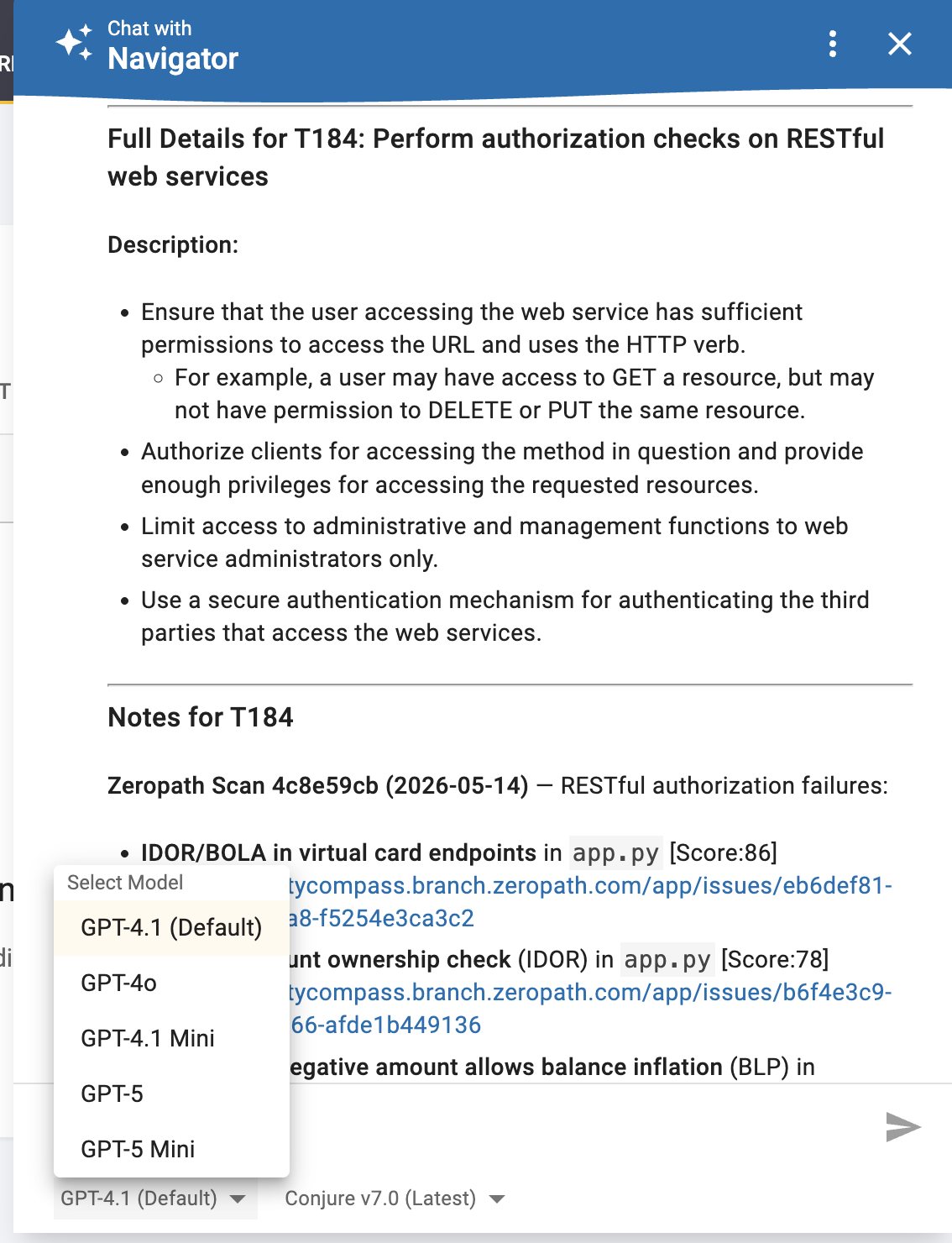
Select Model
Click the model dropdown on the left side of the toolbar to choose the AI model used to generate responses. Available options include:
-
GPT-4.1 (Default) – Recommended for most use cases. Balances accuracy and performance.
-
GPT-4o – Optimized for faster responses.
-
GPT-4.1 Mini – A lighter model suited for simpler queries.
-
GPT-5 – The latest model with enhanced reasoning capabilities.
-
GPT-5 Mini – A lightweight version of GPT-5.
| If you are unsure which model to use, the default (GPT-4.1) is recommended. |
Select Version
Click the version dropdown on the right side of the toolbar to choose which version of the content library Navigator uses when generating responses. Available options include:
-
v6.0 (Older Version) – The stable content version recommended for most deployments.
-
v7.0 (Default & Latest) – The most up-to-date content version, including the following new tools and improvements:
-
Updated default model (GPT-4.1) with the ability to select alternative models from a dropdown.
-
Preliminary guardrails for chat moderation, PII detection, and prompt injection protection.
-
Library tools – List library items; individual lookup for countermeasures, weaknesses, implementations, regulations, and threats; and hybrid search across library content including countermeasures, weaknesses, implementations, and regulation sections.
-
Project tools – Access project details, survey answers, countermeasures with notes, weaknesses, and threats. Results are paginated and display the first 8 items by default; prompt Navigator for additional pages to see more.
-
FAQ – Ask common security questions and receive curated answers from SD Elements content.
-
Translate Text – Translate Navigator responses or security content into other languages.
-
Web Search – Perform preliminary web searches to supplement responses with external context.
-
| Model and version selections apply to subsequent messages in the current session only. They do not persist across sessions. |
What Navigator Can Help You Do
Navigator is powered by the extensive SD Elements library of security content, ensuring that its responses are grounded in trusted, up-to-date knowledge. The following features are included:
-
Context Awareness – Delivers guidance relevant to your current task, project, and role.
-
Semantic Search – Find threats, countermeasures, best practices, and more using natural language.
-
Library & Knowledgebase Lookup – Access countermeasures, weaknesses, implementations, regulations, and threats specific to your organization’s content and standards.
-
Project Lookup – Retrieve survey answers, countermeasures, weaknesses, and threats for a specific project. Results are paginated; prompt Navigator for additional pages to see more.
-
Context-Specific Guidance – Get actionable, security-focused code examples based on your tech stack.
-
FAQ – Ask common security questions and receive curated answers from SD Elements content.
-
Web Page Fetcher – Fetch content from specific documentation pages.
-
Multi-Language Support – Interact in multiple languages and use the Translate Text tool to translate responses or security content directly in chat.
-
Chat Moderation & Safety – Built-in guardrails detect and handle PII, prompt injection, and off-topic requests.
Best Practices
Best practices when prompting Navigator:
-
Be Specific and Contextual – The more relevant detail you provide (task, project, tech stack), the more precise the response. Vague prompts return generic answers.
-
One Question at a Time – Focused prompts produce better results than compound questions.
-
Guide the Source – Use phrases like "based on knowledgebase" or "based on project" to direct Navigator to the right content before generating a response.
-
Choose the Right Model – Use GPT-5 for complex, multi-step questions and GPT-4.1 Mini or GPT-5 Mini for quick lookups. When in doubt, the default (GPT-4.1) covers most use cases well.
-
Stay on the Latest Version – Select v7.0 to get the most current security content, tools, and guidance.
-
Refine if Needed – If a response misses the mark, rephrase your prompt, narrow the scope, or try a different model.